If you buy a plastic clamshell of fresh blueberries at the supermarket and a carton of heavy cream at the dairy aisle, both packages may say “1 Pint”.
Yet, if you poured both containers into identical graduated laboratory cylinders, you would discover an immediate metrological shock:
The dry pint is 16.36% larger in volume than the liquid pint.
In the United States, the customary measurement system maintains two separate, legally distinct definitions for the word “pint”. Conflating the two is one of the most frequent causes of failed baking ratios, unbalanced canning headspaces, and agricultural trade disputes.
Food Safety Advisory (Home Canning & Food Preservation): In home canning and produce preservation, accurate acid-to-vegetable/fruit ratios and container headspaces are essential to ensure heat penetration and inhibit microbial growth (such as Clostridium botulinum). Never substitute dry volume measurements for mass in tested preservation recipes. The USDA Complete Guide to Home Canning recommends measuring all produce and pickling solids by weight (grams or pounds/ounces) using a kitchen scale rather than relying on volume container estimates.
1. Statutory Definitions: NIST Handbook 44 & 130
Under federal weights and measures standards established by the National Institute of Standards and Technology (NIST), the two pints are codified as follows:
| Pint Standard | Exact Volume (mL) | Cubic Inches (cu in) | Fluid Ounces (fl oz) | Standard Kitchen Cups | Legal Trade Application |
|---|---|---|---|---|---|
| US Liquid Pint | 473.176 mL | 28.875 cu in | Exactly 16.0 fl oz | Exactly 2.00 Cups | Water, milk, oils, syrups, beverages |
| US Dry Pint | 550.610 mL | 33.600 cu in | 18.618 fl oz | 2.325 Cups | Fresh berries, cherry tomatoes, grain seeds |
| UK Imperial Pint | 568.261 mL | 34.677 cu in | 20.000 Imperial fl oz | 2.402 US Cups | British pub beers, Commonwealth milk |
   US LIQUID PINT (473.18 mL)                US DRY PINT (550.61 mL)
   ┌─────────────────────────┐              ┌─────────────────────────┐
   │ 16 Fluid Ounces         │              │ 18.62 Fluid Ounces      │
   │ 2.00 Measuring Cups     │  (+16.36%)   │ 2.325 Measuring Cups    │
   │ Standard Water = 1.04 lb│              │ Standard Water = 1.21 lb│
   └─────────────────────────┘              └─────────────────────────┘
2. Why Does the United States Have Two Pints?
The historical split traces back to pre-industrial England, where dry grains and wet liquids were taxed and traded under separate royal standards:
- The Queen Anne Wine Gallon (1707): Defined as 231 cubic inches for liquids. Dividing by 8 yields the US Liquid Pint (28.875 cubic inches / 473.18 mL).
- The Winchester Corn Bushel (1696): Defined as 2,150.42 cubic inches for dry grains, wheat, and produce. Dividing by 64 pints yields the US Dry Pint (33.600 cubic inches / 550.61 mL).
When the British Parliament standardized their empire under the Weights and Measures Act of 1824, they abolished both older systems and created the unified Imperial Pint (568.26 mL / 20 Imperial fluid ounces).
The young United States, having already declared independence, preserved both the 1707 wine gallon and the 1696 Winchester grain bushel. As a result, American consumers today still navigate two distinct pints!
3. The Physical Reason: Why Dry Goods Need a Larger Container
Why did historical agricultural merchants demand a larger volume for dry goods?
The answer is particulate void geometry:
- When you fill a 1-pint container with liquid water or whole milk, the fluid molecules form a continuous, void-free matrix with 0% empty air space.
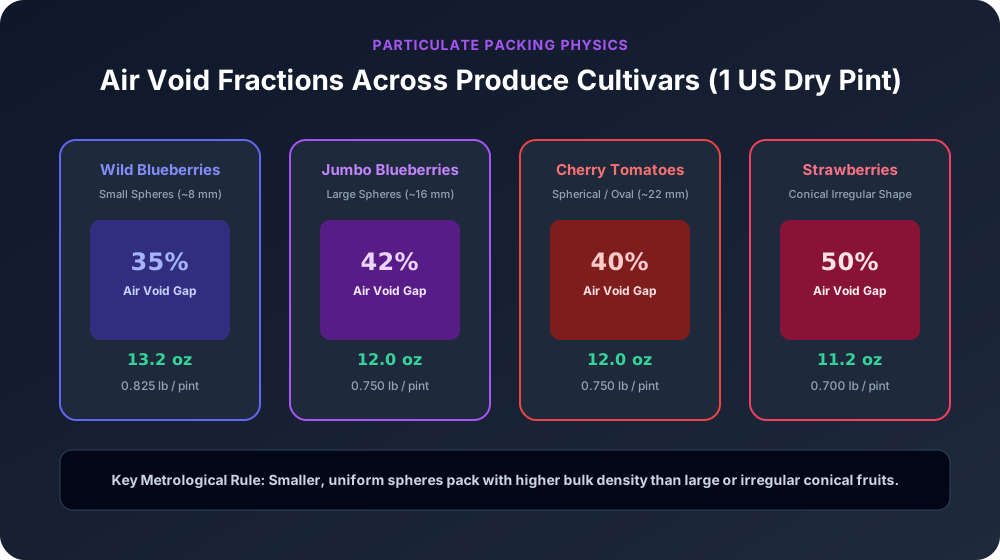
- When you fill a 1-pint basket with spherical blueberries, bumpy raspberries, or whole cherry tomatoes, the fruits cannot touch at every boundary. Air pockets fill the interstitial gaps.
- In a standard clamshell of cultivated blueberries, 36% to 40% of the container volume is unoccupied air!
To ensure that a consumer purchasing a “pint” of fresh fruit received an adequate mass of actual food rather than a container mostly filled with empty space, historical agricultural markets established the larger 33.6-cubic-inch dry pint.
4. Kitchen Recipe Pitfalls: The Measuring Cup Trap
The most common kitchen mistake occurs when a recipe calls for “1 pint of fresh berries” and the cook measures 2 cups in a Pyrex liquid measuring jug:
- What the recipe meant: A standard supermarket produce clamshell (1 US Dry Pint = 550.6 mL = 2.32 cups).
- What the cook measured: Two liquid measuring cups (473.2 mL).
- The resulting deficit: The pie filling or jam batch is short by 77.4 mL of fruit (about 14% of the fruit mass), throwing off the gelling pectin-to-sugar ratio.
Conversion Rules of Thumb:
- If a recipe calls for 1 pint of fresh berries, use the full commercial clamshell basket, which yields about 2¼ to 2½ cups of whole fruit.
- If scaling commercial recipes by weight, remember that a dry pint of blueberries weighs about 12 ounces (0.75 lb / 340 grams), whereas a liquid pint of water weighs 16.7 ounces (1.04 lb).
5. Related Conversion Tools
- Calculate produce weights with our Dry Pint to Pound Produce Converter.
- Convert measuring cups directly to mass with our Cup to Pound Baking Scaler.
- Explore individual produce densities for Blueberries, Strawberries, and Cherry Tomatoes.