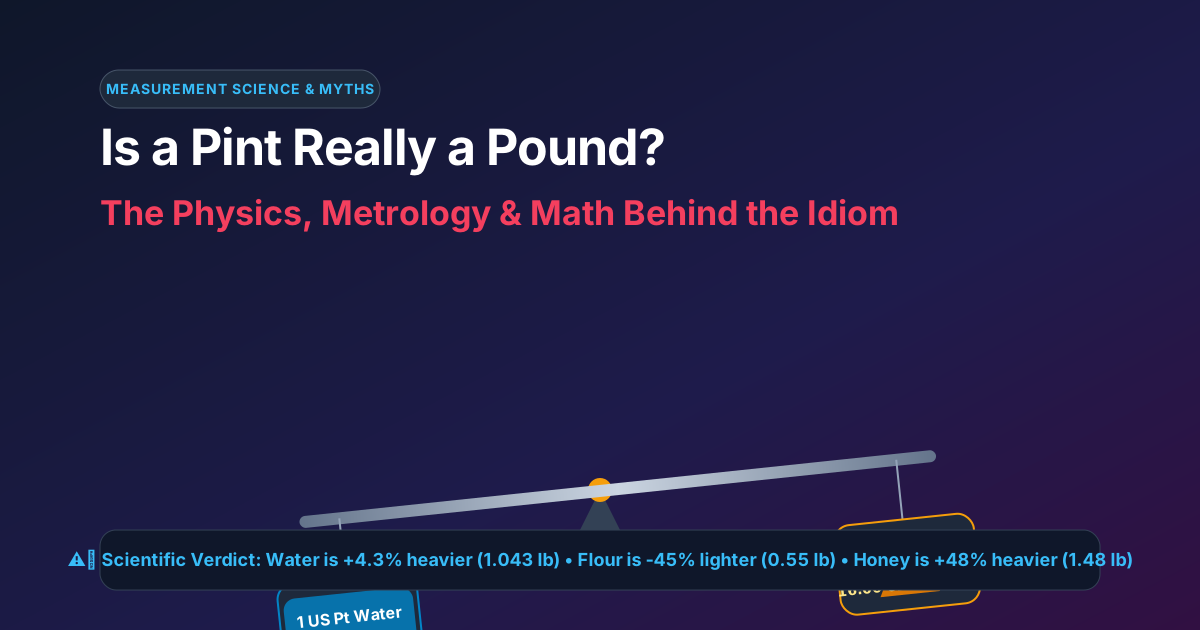
The centuries-old culinary rhyme “a pint’s a pound the world around” has guided home bakers, tavern keepers, and market vendors for generations. It is catchy, memorable, and rhythmically satisfying. Unfortunately, from the perspectives of physical metrology, fluid mechanics, and professional gastronomy, it is mathematically and physically false.
If you rely on this heuristic in high-precision baking, commercial food manufacturing, brewing, or scientific formulation, you are introducing errors ranging from 4.3% for plain water to over 48% for common pantry staples like honey, flour, or rolled oats.
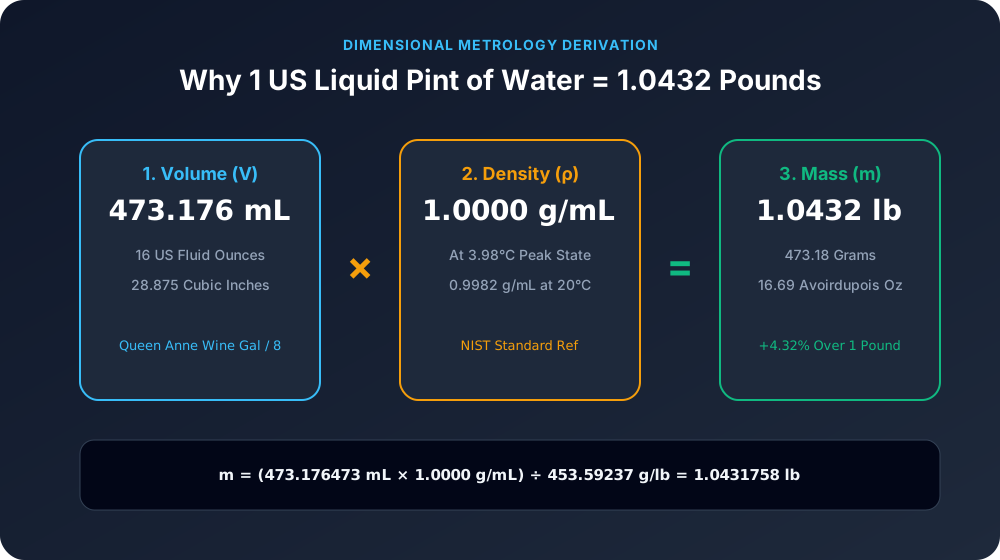
Figure 1: Metrological breakdown of 1 US Liquid Pint of pure water (473.18 mL) vs. 1 Avoirdupois Pound (453.59 g), proving the innate 4.32% mass surplus.
1. Executive Summary & Metrological Verdict
To settle the question immediately across all standard systems of measurement:
| Liquid & Unit System | Measured Volume | Theoretical Mass of Water | Avoirdupois Weight | Variance from 1.000 lb |
|---|---|---|---|---|
| US Liquid Pint (Pure Water at 4°C) | 473.176 mL | 473.176 g | 1.0432 lb (16.69 oz) | +4.32% Heavy |
| US Liquid Pint (Room Temp Water at 20°C) | 473.176 mL | 472.324 g | 1.0413 lb (16.66 oz) | +4.13% Heavy |
| UK / Imperial Pint (Pure Water at 62°F) | 568.261 mL | 568.261 g | 1.2528 lb (20.04 oz) | +25.28% Heavy |
| US Dry Pint (Water Displacement Equiv) | 550.610 mL | 550.610 g | 1.2139 lb (19.42 oz) | +21.39% Heavy |
The takeaway is absolute: 1 US pint of water weighs approximately 1.043 pounds (16.69 ounces), not 1.000 pound. In the United Kingdom and Commonwealth nations, an Imperial pint of water weighs 1.253 pounds (20.04 ounces)—a full quarter-pound heavier!
2. Historical Origins: How Did the Myth Start?
To understand how this misconception became cemented into everyday culture, we have to look back at the history of Anglo-American trade before the advent of electronic scales and the International System of Units (SI).
The Medieval Winchester Standard & Colonial Trade
In 14th-century England, grain and ale merchants used traditional wooden vessels to measure dry goods and spirits. The traditional English corn pint and ale pint were loosely calibrated around the weight of sixteen ounces of wheat grains or fresh well water.
When English colonists crossed the Atlantic to North America in the 17th and 18th centuries, they carried these vernacular idioms with them. In the rough-and-tumble environment of colonial trading posts, where standardized, calibrated brass scales were rare luxury items, colonial merchants needed an intuitive rule of thumb.
Because one US pint (16 fluid ounces) of water is close to sixteen avoirdupois ounces of weight (16.69 oz vs 16.00 oz), the phrase was coined as an acceptable commercial estimate:
“A pint’s a pound the world around.”
The British Schism of 1824
While the United States retained the pre-Revolutionary British Queen Anne wine gallon (1707) and Winchester bushels, Great Britain underwent a radical metrological overhaul.
In 1824, the British Parliament enacted the Weights and Measures Act of 1824, abolishing the wine gallon, ale gallon, and corn gallon. They instituted the Imperial Gallon, explicitly defined as the volume occupied by 10 imperial pounds of distilled water weighed in air with brass weights at 62°F with a barometric pressure of 30 inches of mercury.
Because an Imperial gallon contains exactly eight Imperial pints:
Mass of 1 Imperial Pint of Water = 10 lbs ÷ 8 = 1.25 lbs = 20 Imperial fluid ouncesConsequently, across the British Empire, the nursery rhyme was immediately amended to reflect reality:
“A pint of pure water weighs a pound and a quarter!”
3. The Physics & Thermodynamics of Water Weight
Why doesn’t a US pint of water weigh exactly 1.000 pound? The answer lies in the formal definition of volume units and fluid density thermodynamics.
       MASS (m)
      /        \
     /  m = V × ρ \
    /              \
VOLUME (V)    x   DENSITY (ρ)
The fundamental equation of mass is:
Mass (m) = Volume (V) × Density (ρ)Where:
- m is the mass in grams or pounds,
- V is the volumetric capacity (mL or fluid ounces),
- ρ (rho) is the density of the substance (g/mL or lb/fl oz).
Mathematical Proof for 1 US Liquid Pint of Water
- Volumetric Definition: By statutory US definition (NIST Handbook 44), 1 US Liquid Gallon = 231 cubic inches = 3.785411784 Litres.
- There are 8 pints in a gallon:
Volume of 1 US Pint = 3,785.411784 mL ÷ 8 = 473.176473 mL - Density of Pure Water: Pure water (H2O) reaches its maximum density at 3.98°C (39.16°F), where density ρ = 0.999972 g/cm³ ≈ 1.0000 g/mL.
- Calculating total grams:
Mass = 473.176473 mL × 1.0000 g/mL = 473.176 grams - Converting to Avoirdupois Pounds (1 lb = 453.59237 grams):
Weight in Pounds = 473.176473 g ÷ 453.59237 g/lb = 1.043175 lb - Converting to Avoirdupois Ounces (1 lb = 16 oz):
Weight in Ounces = 1.043175 × 16 = 16.6908 oz
Water Density Variation Across Temperatures
Water expands and contracts with temperature, subtly shifting the true weight of a pint:
| Temperature | Water Density (g/cm³) | Weight of 1 US Pint (lb) | Weight of 1 US Pint (oz) |
|---|---|---|---|
| 0°C (32°F - Freezing) | 0.9998 | 1.0430 lb | 16.688 oz |
| 4°C (39.2°F - Max Density) | 1.0000 | 1.0432 lb | 16.691 oz |
| 20°C (68°F - Room Temp) | 0.9982 | 1.0413 lb | 16.661 oz |
| 50°C (122°F - Hot Tap) | 0.9880 | 1.0307 lb | 16.491 oz |
| 100°C (212°F - Boiling) | 0.9584 | 0.9998 lb | 15.997 oz |
Notice that only near boiling temperature (100°C / 212°F) does 1 US pint of water dip to 1.000 pound!
4. The Culinary Density Disaster: 15 Everyday Ingredients
While a 4.3% error in water is noticeable in industrial chemistry, applying the “pint’s a pound” rule to cooking ingredients causes complete disaster.
Bulk density varies dramatically depending on molecular weight, moisture, sugar concentration, and aeration.
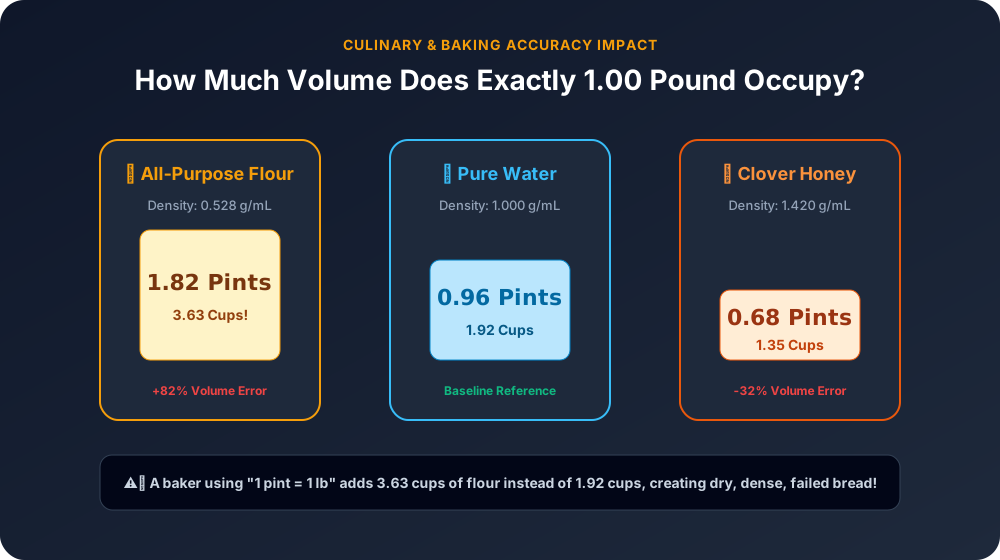
Figure 2: The Culinary Density Spectrum. Identical 1-pint vessels filled with honey, water, flour, and oats exhibit massive weight variations from 0.42 lb to 1.48 lb.
Master Ingredient Weight Concordance Table (1 US Liquid Pint = 2 Cups)
| Ingredient | Bulk Density (g/mL) | Mass (Grams) | Net Weight (Pounds) | Net Weight (Ounces) | % Error if Assumed 1.000 lb |
|---|---|---|---|---|---|
| Clover Honey | 1.420 | 671.9 g | 1.481 lb | 23.70 oz | +48.1% (Massive Excess) |
| Unsulphured Molasses | 1.400 | 662.4 g | 1.460 lb | 23.37 oz | +46.0% (Massive Excess) |
| Pure Maple Syrup | 1.370 | 648.3 g | 1.429 lb | 22.87 oz | +42.9% (Massive Excess) |
| Corn Syrup | 1.380 | 653.0 g | 1.440 lb | 23.03 oz | +44.0% (Massive Excess) |
| Fine Table Salt | 1.200 | 567.8 g | 1.252 lb | 20.03 oz | +25.2% (Over-salted) |
| Whole Milk (3.25%) | 1.030 | 487.4 g | 1.074 lb | 17.19 oz | +7.4% |
| Pure Water (20°C) | 0.998 | 472.3 g | 1.041 lb | 16.66 oz | +4.1% |
| Heavy Whipping Cream | 0.994 | 470.3 g | 1.037 lb | 16.59 oz | +3.7% |
| Extra Virgin Olive Oil | 0.918 | 434.4 g | 0.958 lb | 15.32 oz | -4.2% |
| Canola / Vegetable Oil | 0.920 | 435.3 g | 0.960 lb | 15.35 oz | -4.0% |
| Granulated White Sugar | 0.850 | 402.2 g | 0.887 lb | 14.19 oz | -11.3% |
| Brown Sugar (Firmly Packed) | 0.920 | 435.3 g | 0.960 lb | 15.35 oz | -4.0% |
| All-Purpose Flour (Dip & Sweep) | 0.600 | 283.9 g | 0.626 lb | 10.01 oz | -37.4% (Severely Under) |
| All-Purpose Flour (Spoon & Level) | 0.528 | 250.0 g | 0.551 lb | 8.82 oz | -44.9% (Severely Under) |
| Powdered Sugar (Un-sifted) | 0.560 | 265.0 g | 0.584 lb | 9.35 oz | -41.6% |
| Rolled Oats (Old Fashioned) | 0.400 | 189.3 g | 0.417 lb | 6.68 oz | -58.3% (Over Half-Empty) |
5. Baking Science: Why Volume Measuring Causes Recipe Failures
In pastry arts and baking, hydration and flour ratios are calculated using Baker’s Percentages, where the total weight of flour represents 100%.
When a baker mistakes a pint (volume) for a pound (weight), the chemical balance of doughs and batters collapses:
Failure Mode 1: Dry, Tough, or Crumbly Bread
If a sourdough recipe calls for “1 pound of water (454 g)” and the baker pours “1 pint of water (472 g)”, the dough hydration increases from 65% to 68%. If the baker then uses a 1-pint measure for “1 pound of flour,” they actually add only 250 g of flour instead of 454 g! The hydration skyrockets to over 188%, turning bread dough into soup.
Failure Mode 2: Collapsed Cakes & Rubbery Crumb
Cakes depend on a delicate structural matrix of coagulated egg proteins, gelatinized starches, and melted sugar.
- Adding 1 pint of honey instead of 1 pound of honey introduces 0.48 lb (217 g) of excess sugar and moisture, preventing the crumb from setting and causing the cake center to sink.
The Aeration Factor in Dry Goods
Dry ingredients are porous particulates. A pint cup dipped directly into a compressed bag of flour packs tightly (10 oz), while flour fluffed with a fork, spooned into the cup, and leveled with a knife weighs barely 8.8 oz.
A simple technique variation changes your ingredient weight by 13.6% without altering volume by a single millimeter.
6. How to Accurately Convert Between Pints and Pounds
To achieve perfect culinary and scientific results, always calculate weight using precise bulk density:
Step 1: Identify Your Pint Standard
- US Liquid Pint = 473.176 mL (Standard US measuring cups: 2 cups = 1 pint).
- Imperial Pint = 568.261 mL (UK / Commonwealth measuring jugs).
- US Dry Pint = 550.610 mL (Produce baskets, berries, dry grains).
Step 2: Apply the Conversion Formula
Weight in Pounds = (Pints × Milliliters per Pint × Density in g/mL) ÷ 453.59237Example: Converting 3 US Liquid Pints of Clover Honey (Density = 1.42 g/mL):
Weight = (3 × 473.176 mL × 1.42 g/mL) ÷ 453.59237 = 2015.73 g ÷ 453.59237 = 4.444 pounds (71.1 oz)Rather than computing these calculations manually by hand, you can use our instant interactive Pint to Pound Calculator or our specialized Density Converter.
7. Frequently Asked Questions (FAQ)
Is 16 fluid ounces always 16 ounces in weight?
No. Fluid ounces measure three-dimensional volume (1 US fl oz = 29.57 mL), whereas ounces (avoirdupois) measure gravitational mass (1 oz = 28.35 g). They only match for liquids with a density of exactly 0.958 g/mL (such as hot vegetable oil at 180°F). For room-temperature water, 16 fluid ounces weighs 16.69 ounces.
Why do some American cookbooks claim a pint is a pound?
Historic American home economics programs from the late 19th and early 20th centuries promoted “a pint’s a pound” as a mnemonic for novice home cooks preparing simple gravies, broths, and stews. In low-precision rustic cooking, a 4% variance in water or stock is rarely noticeable, allowing the myth to persist.
How much does a pint of milk weigh?
One US liquid pint of whole milk (3.25% butterfat) weighs 1.074 pounds (17.19 ounces or 487.4 grams) due to dissolved milk sugars (lactose), proteins (casein), and minerals (calcium) increasing its density to 1.030 g/mL.
What is the British equivalent of the saying?
In the United Kingdom, the historical rhyme is “A pint of pure water weighs a pound and a quarter,” because 1 Imperial pint of water (568.26 mL) weighs exactly 1.2528 pounds (20.04 oz).
Related Tools & Metrology Guides
- Interactive Pint to Pound Calculator — Instant multi-ingredient conversions.
- US Liquid vs. Imperial vs. Dry Pint Guide — The full history and metric comparison.
- Why Produce Pint Weights Vary — Clamshell packing, void fractions, and berry physics.
- Liquid vs. Dry Measurement Converter — Density tables and volumetric formulas.