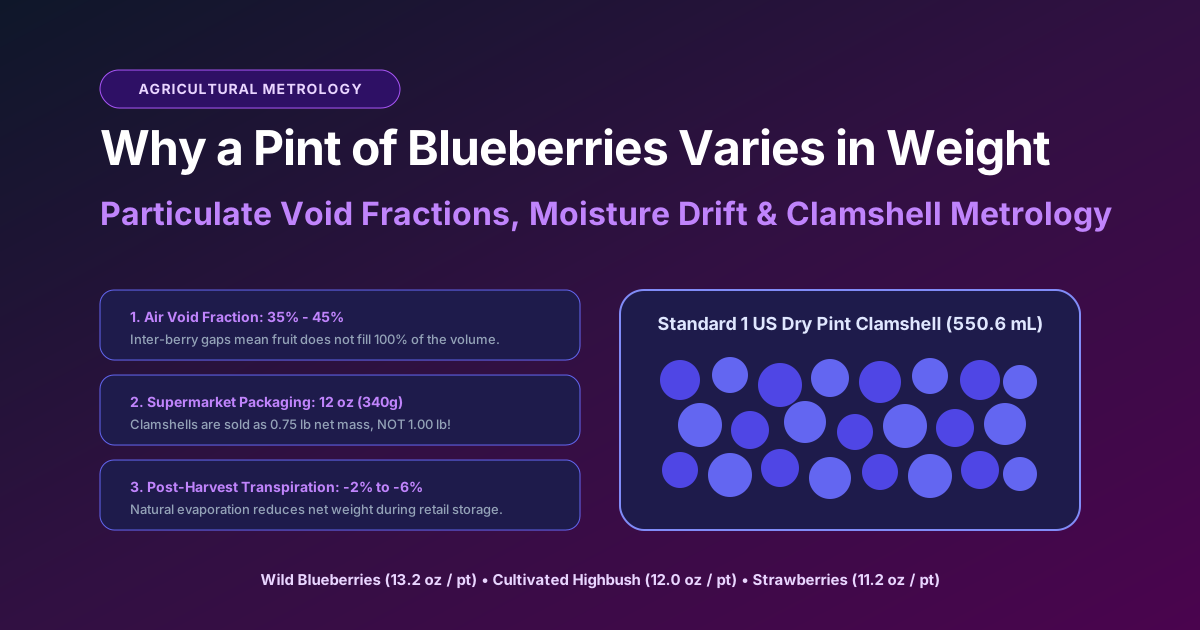
When shopping in the fresh produce aisle or picking fruit at a local orchard, you will frequently see fresh berries, cherry tomatoes, and Brussels sprouts packaged in clear plastic clamshells or wooden veneer hallocks labeled “1 Pint”.
Yet, if you place several different 1-pint clamshells on a precision kitchen scale, you will find significant weight variations:
- Wild Maine Blueberries: 13.8 oz (0.86 lb)
- Large Cultivated Blueberries: 11.8 oz (0.74 lb)
- Fresh Raspberries: 9.2 oz (0.58 lb)
- Sweet Cherry Tomatoes: 12.5 oz (0.78 lb)
Why doesn’t a pint of produce have a single, fixed weight? The explanation involves particulate packing geometry, interstitial void fractions, biological transpiration, and the legal difference between US dry volume and supermarket net weight standards.
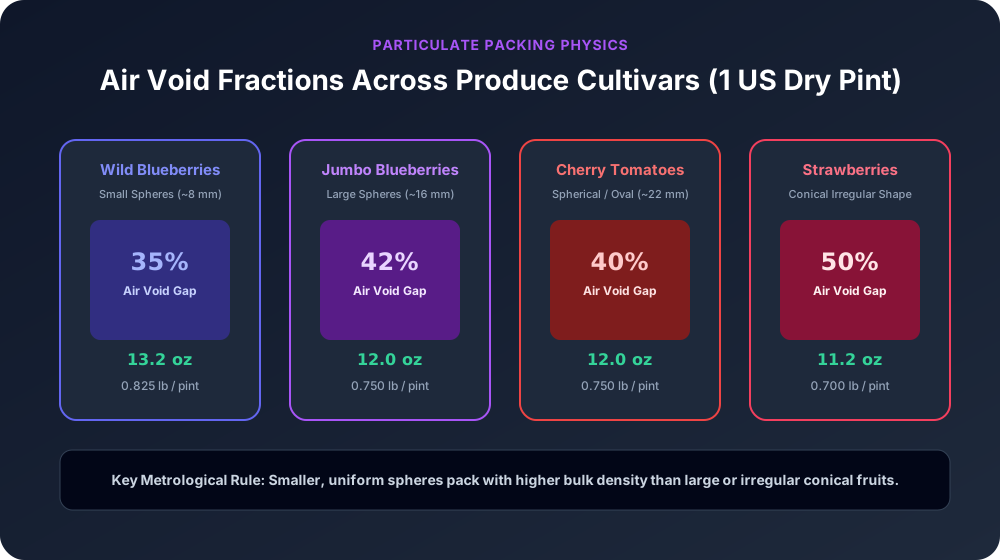
Figure 1: Particulate sphere packing geometry. Smaller berries achieve higher random close packing density with lower interstitial air voids (36%) compared to large berries (45% air).
1. Dry Pint (Volume) vs. Supermarket Net Weight
To understand produce weights, we must first distinguish between statutory volume and commercial packaging tare weight:
The Statutory US Dry Pint
In United States agricultural metrology (NIST Handbook 130), 1 US Dry Pint is defined as:
1 US Dry Pint = 33.600 cubic inches = 550.610 cubic centimeters (mL)If this volume were filled with continuous pure liquid water, it would weigh 1.2139 pounds (19.42 ounces or 550.6 grams).
The Retail Supermarket Standard (12 oz / 340 g)
Produce is made of discrete solid units with irregular shapes. Air fills the spaces between each berry.
To create uniform nationwide pricing, the USDA and wholesale packing associations standardized the standard commercial blueberry clamshell container to a target net weight of:
Target Retail Net Weight = 12 ounces (340 grams / 0.75 lb)When supermarkets sell a plastic clamshell marked “1 Pint”, federal packaging regulations (NIST Handbook 133) require the package to meet a minimum net weight (typically 12 oz for blueberries and cherry tomatoes, or 6 oz / 170 g for half-pint delicate raspberries).
2. The Mathematics of Sphere Packing & Void Fractions
Why do different fruits—or even different varieties of the same fruit—fill that 550.61 cm³ volume with different amounts of mass? The answer is governed by particulate sphere packing theory.
   POWDER / LIQUID (0% Void)        SMALL BERRIES (36% Void)        LARGE BERRIES (46% Void)
  ┌─────────────────────────┐     ┌─────────────────────────┐     ┌─────────────────────────┐
  │█████████████████████████│     │  (●) (●) (●) (●) (●)    │     │   ( ● )   ( ● )   ( ● ) │
  │█████████████████████████│     │ (●) (●) (●) (●) (●) (●) │     │ ( ● )   ( ● )   ( ● )   │
  │█████████████████████████│     │  (●) (●) (●) (●) (●)    │     │   ( ● )   ( ● )   ( ● ) │
  └─────────────────────────┘     └─────────────────────────┘     └─────────────────────────┘
      Density: 1.00 g/mL              Density: 0.70 g/mL              Density: 0.61 g/mL
      Weight: 1.21 lb                 Weight: 0.85 lb                 Weight: 0.74 lb
The Kepler Conjecture & Random Close Packing
- In 1611, Johannes Kepler conjectured (later proven by Thomas Hales in 1998) that the maximum theoretical packing density for uniform spheres is ≈ 74.05% (face-centered cubic or hexagonal close packing).
- In real-world harvesting where berries are poured into containers without manual alignment, they settle into Random Close Packing (RCP), which has a maximum density limit of ≈ 63.5% to 64.0%.
- This means that in an ideal berry pack, at least 36% of the container is unoccupied air!
Real-World Produce Packing & Void Fraction Table (1 US Dry Pint = 550.6 mL)
| Produce Item | Physical Geometry & Structure | Void Fraction (% Air) | Bulk Density (g/cm³) | Net Weight (Ounces) | Net Weight (Pounds) |
|---|---|---|---|---|---|
| Wild Blueberries (Vaccinium angustifolium) | Small spheres (6–9 mm), tight packing | 34%–38% | 0.68–0.73 | 13.2–14.2 oz | 0.83–0.89 lb |
| Cultivated Highbush Blueberries (Standard) | Medium spheres (12–16 mm) | 40%–45% | 0.60–0.65 | 11.6–12.6 oz | 0.73–0.79 lb |
| Jumbo Blueberries (Eureka / Sekoya) | Large spheres (18–24 mm), bridging | 45%–50% | 0.54–0.58 | 10.5–11.2 oz | 0.66–0.70 lb |
| Cherry / Grape Tomatoes | Firm ovoids / spheres | 38%–44% | 0.62–0.68 | 12.0–13.2 oz | 0.75–0.83 lb |
| Strawberries (Whole, Medium) | Conical shapes with stem gaps | 45%–52% | 0.52–0.58 | 10.1–11.3 oz | 0.63–0.71 lb |
| Blackberries | Aggregate drupelets, soft contours | 48%–54% | 0.50–0.56 | 9.7–10.8 oz | 0.61–0.68 lb |
| Raspberries | Hollow core cup, fragile | 55%–62% | 0.42–0.48 | 8.1–9.3 oz | 0.51–0.58 lb |
| Brussels Sprouts | Dense layered leafy globes | 44%–50% | 0.55–0.62 | 10.7–12.0 oz | 0.67–0.75 lb |
3. Post-Harvest Transpiration: The Weight Loss Timeline
Even after a container is filled with exact precision at the packaging facility, fresh produce continues to lose mass continuously through biological respiration and transpiration.
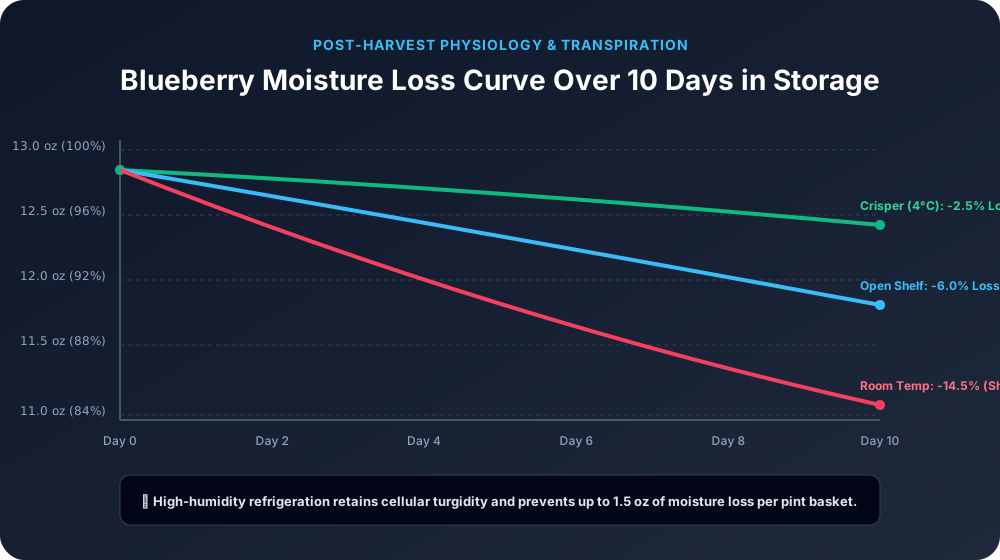
Figure 2: Daily moisture weight loss comparison. Berries stored at ambient room temperature (20°C / 68°F) lose up to 7.2% of their initial weight over 7 days compared to just 1.5% in controlled cold-chain storage (2°C / 35.6°F).
The Transpiration Mechanism
Berries are 84% to 88% water by weight. Once harvested from the bush, they are cut off from their water supply but continue cellular metabolic respiration, expelling water vapor through their epidermis and micro-pores.
- Vapor Pressure Deficit (VPD): In dry supermarket display cases or home kitchens (low relative humidity), water evaporates rapidly from the fruit skin.
- Vibration Settling in Transit: As trucks transport fruit across interstate highways, road vibrations shake the berries into a tighter resting configuration (3–5% volume reduction), giving the appearance of a partially empty basket.
4. Culinary Implications: Canning, Jams, and Pastry Science
Why does this matter in the kitchen? Measuring fresh produce by volumetric pints instead of mass leads to predictable culinary failures:
1. The Pectin & Acid Balance in Jam Making
High-quality fruit preserves depend on the Sugar-Acid-Pectin Gel Matrix:
- Pectin requires an exact concentration of sugar (60%–65% soluble solids) and acid (pH 3.0–3.3) to form a stable polymer mesh at 104.5°C (220°F).
- If a strawberry jam recipe calls for “4 pints of strawberries” and you use large cultivated berries (10.5 oz/pint) instead of small berries (13.5 oz/pint), you will introduce 12 oz less fruit mass than expected, resulting in a rock-hard over-sugared candy rather than a spreadable jam.
2. Blueberry Pie Filling Liquefaction
Blueberry pies require tapioca or cornstarch thickener calibrated to the exact weight of berry juice released during baking.
- If your 4-pint measure underfills on weight, your thickener will produce a gluey paste.
- If your 4-pint measure is tightly packed wild berries with 20% more water content, the pie filling will fail to set, flooding the bottom crust with liquid.
5. Summary & Conversion Heuristics for Cooks
When shopping and following recipes, keep these practical rules of thumb in mind:
┌─────────────────────────────────────────────────────────────┐
│             PRODUCE PINT QUICK REFERENCE HEURISTICS         │
├─────────────────────────────────────────────────────────────┤
│ 1 Standard Supermarket Clamshell Blueberry Pint = 12.0 oz   │
│ 1 Farmers Market Dry Pint Basket of Blueberries = 13.5 oz   │
│ 1 Dry Pint of Whole Strawberries                = 11.0 oz   │
│ 1 Dry Pint of Cherry Tomatoes                   = 12.5 oz   │
│ 1 Dry Pint of Fresh Raspberries / Blackberries  = 9.5 oz    │
│ 1 Flat of Blueberries (12 Dry Pints)            = 9.0 lbs   │
└─────────────────────────────────────────────────────────────┘
For foolproof culinary consistency, always weigh produce with a digital kitchen scale using our interactive tools:
- Interactive Blueberry Pint to Pound Tool
- Strawberry Pint to Pound Calculator
- Cherry Tomato Pint to Pound Tool
- Raspberry Pint to Pound Calculator
- US Dry Pint to Pound General Calculator
6. Frequently Asked Questions (FAQ)
How many cups of blueberries are in a 1-pint clamshell?
A standard 12 oz supermarket clamshell of blueberries yields approximately 2 to 2.25 level US cups of fresh fruit.
How much does a flat of blueberries weigh?
A commercial wholesale master flat containing 12 one-pint clamshells typically weighs 9.0 to 9.6 pounds net weight (4.1–4.35 kg), plus cardboard tray tare weight.
Why are raspberries sold in half-pint clamshells (6 oz)?
Raspberries possess a hollow central receptacle cavity after being pulled from the plant stem. Due to their fragile cellular structure, stacking raspberries to the full depth of a 1-pint clamshell causes bottom berries to crush under the weight of upper layers, weeping juice and rotting within 48 hours.
Should I wash berries before weighing them?
No. Washing berries before weighing adds surface moisture weight (up to 5% surplus water) and strips the natural protective waxy cuticle layer (the “bloom”), accelerating mold growth. Always weigh dry, unwashed berries and wash immediately prior to consumption.