If you have ever attempted to bake an authentic British sticky toffee pudding using American measuring cups, or ordered a draught beer in London and noticed the glass looked significantly taller than your domestic shaker pint, you have encountered the transatlantic pint paradox.
The English word “pint” is legally recognized in dozens of countries, yet it describes three fundamentally distinct volumetric standards:
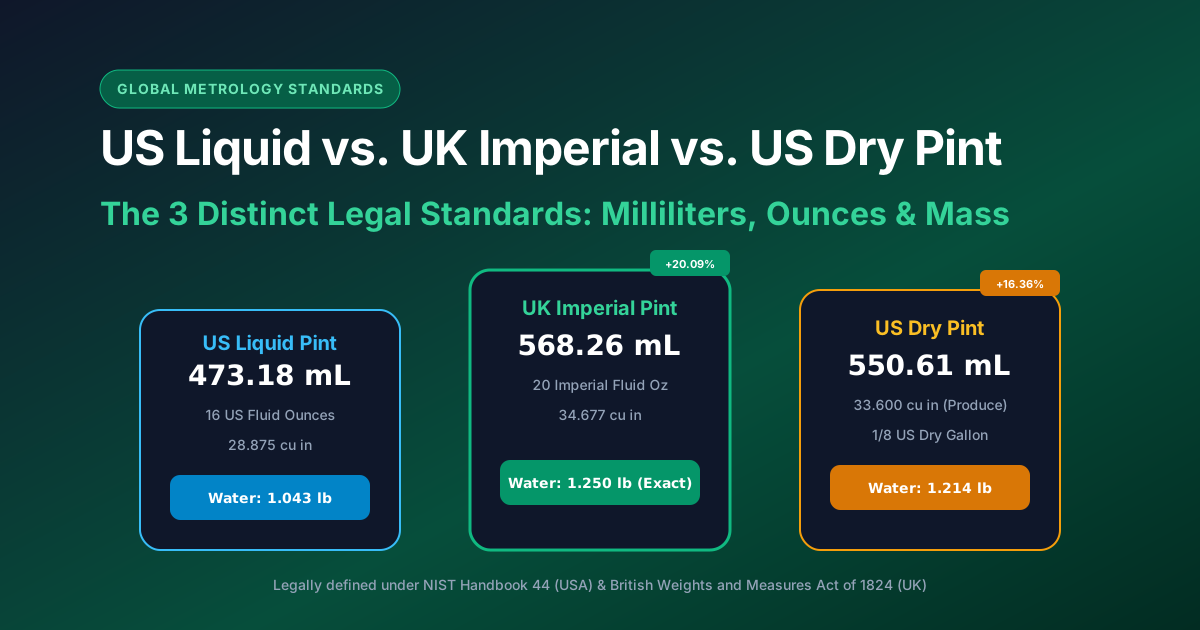
- The US Liquid Pint (473.18 mL) — The universal liquid standard in the United States.
- The UK / Imperial Pint (568.26 mL) — The legal standard across the United Kingdom, Ireland, Canada, Australia, and New Zealand.
- The US Dry Pint (550.61 mL) — The statutory agricultural unit for fresh berries, cherry tomatoes, and dry bulk commodities in the US.
Failing to distinguish between these units introduces immediate volumetric errors of 16.4% to 20.1%, easily ruining delicate culinary emulsions or commercial shipments.
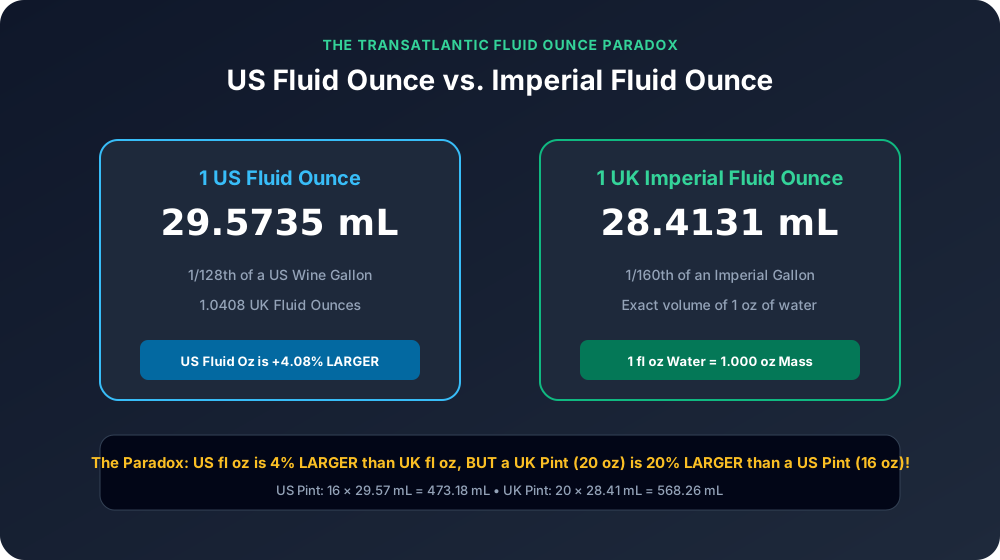
Figure 1: Side-by-side volumetric and fluid ounce analysis across the three legal pint systems, illustrating the 20.09% surplus of the Imperial pint.
1. Master Concordance & Comparison Matrix
Here is the exact mathematical and physical breakdown of the three global pint systems:
| Metrological Parameter | US Liquid Pint | UK / Imperial Pint | US Dry Pint |
|---|---|---|---|
| Legal Authority | NIST Handbook 44 (US) | Weights & Measures Act 1985 (UK) | USDA / NIST Handbook 130 |
| Volume in Milliliters | 473.176 mL | 568.261 mL | 550.610 mL |
| Volume in Liters | 0.47318 L | 0.56826 L | 0.55061 L |
| Fluid Ounces Contained | 16 US fl oz | 20 Imperial fl oz | ≈ 18.62 US fl oz equiv |
| Cubic Inches (in³) | 28.875 in³ | 34.677 in³ | 33.600 in³ |
| Cubic Centimeters (cm³) | 473.176 cm³ | 568.261 cm³ | 550.610 cm³ |
| Weight of Pure Water (4°C) | 1.0432 lb (16.69 oz) | 1.2528 lb (20.04 oz) | 1.2139 lb (19.42 oz) |
| Fraction of Standard Gallon | 1/8 US Liquid Gallon | 1/8 Imperial Gallon | 1/8 US Dry Gallon (1/64 Bushel) |
| Primary Practical Application | Milk, beer, oil, liquids (US) | Draught beer, milk, recipes (UK) | Berries, grapes, tomatoes (US) |
Direct Scaling Multipliers
To quickly convert between any two pint formats, use these exact metrological ratios:
- From US Liquid to Imperial: Multiply volume by 0.8327 (or divide by 1.2009).
- From Imperial to US Liquid: Multiply volume by 1.2009 (an Imperial pint is +20.09% larger).
- From US Liquid to US Dry: Multiply volume by 0.8594 (or divide by 1.1636).
- From US Dry to US Liquid: Multiply volume by 1.1636 (a Dry pint is +16.36% larger).
- From US Dry to Imperial: Multiply volume by 0.9689 (an Imperial pint is +3.21% larger).
2. The Fluid Ounce Paradox: Why UK Ounces are Smaller, but UK Pints are Bigger
One of the most confusing aspects of international metrology is the relationship between the US fluid ounce and the Imperial fluid ounce:
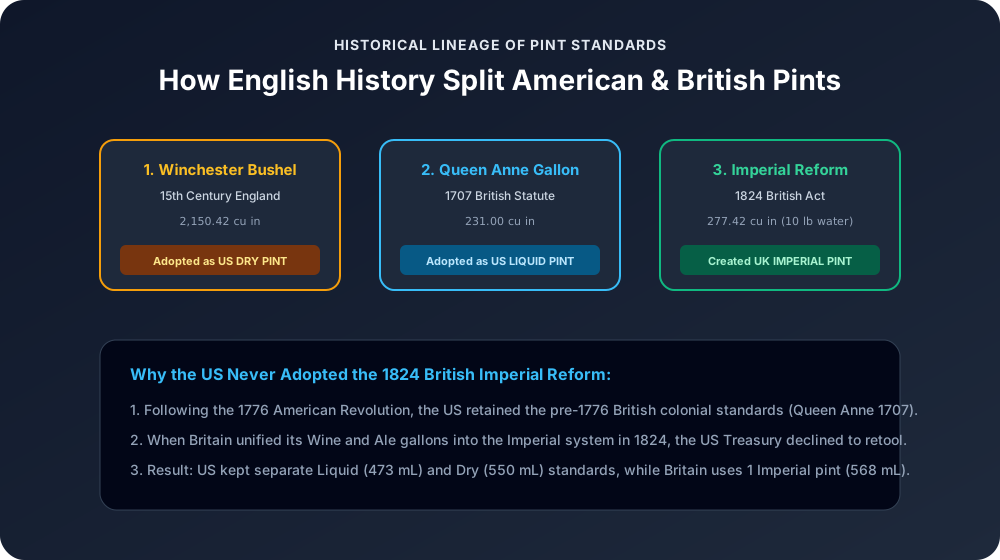
Figure 2: Metrological genealogy: How the 1707 Queen Anne Wine Gallon and Winchester Bushel split from the 1824 British Imperial reform.
The Math Behind the Paradox
- 1 US Fluid Ounce = 1/128 of a US Gallon = 3785.41 mL ÷ 128 = 29.5735 mL
- 1 Imperial Fluid Ounce = 1/160 of an Imperial Gallon = 5682.61 mL ÷ 160 = 28.4131 mL
Notice that an individual US fluid ounce is 4.08% larger than an Imperial fluid ounce (29.57 mL vs 28.41 mL).
Yet, a UK / Imperial pint is 20.09% larger than a US pint because:
- A US pint contains 16 fluid ounces (16 × 29.5735 mL = 473.18 mL).
- An Imperial pint contains 20 fluid ounces (20 × 28.4131 mL = 568.26 mL).
In the UK system, 1 Imperial fluid ounce of water was designed to weigh exactly 1 avoirdupois ounce (28.35 g). Therefore, 20 Imperial fluid ounces of water weighs exactly 20 ounces (1.25 lbs).
3. The Historical Schism: 1707 Queen Anne vs. 1824 British Reform
Why does this transatlantic split exist in the first place? It is the result of differing historical trajectories in standardizing trade measures.
The Queen Anne Wine Gallon of 1707
In 1707, during the reign of Queen Anne of Great Britain, the English Parliament standardized the taxation of imported wine by formalizing the Wine Gallon as a cylinder 7 inches in diameter and 6 inches deep, equaling exactly 231 cubic inches.
When American merchants declared independence in 1776, this 231-cubic-inch gallon was the legal commerce standard throughout the Thirteen Colonies. In 1832, the US Treasury Department formally standardized on the Queen Anne gallon. Under this system:
1 US Liquid Pint = 231 cubic inches ÷ 8 = 28.875 cubic inches (473.176 mL)The British Imperial Act of 1824
In 1824, Britain realized its commerce was plagued by three competing, incompatible gallon definitions:
- The Wine Gallon (231 in³),
- The Ale Gallon (282 in³), and
- The Corn / Winchester Gallon (268.8 in³).
To eliminate market fraud, the British Parliament enacted the Weights and Measures Act of 1824. They abolished all three historical gallons and defined the new Imperial Gallon based on the mass of pure water:
1 Imperial Gallon = The volume of 10 pounds of distilled water weighed in air with brass weights at 62°F (277.419 cubic inches / 4.54609 Litres).
Dividing this by 8 yielded the modern 568.261 mL Imperial Pint, which remained the legal standard across the British Commonwealth.
4. The US Dry Pint: The Forgotten Agricultural Standard
Many cooks and shoppers are unaware that the United States maintains two distinct statutory pints: Liquid and Dry.
The Winchester Bushel
The US Dry Pint derives from the historic Winchester Bushel (2,150.42 cubic inches), which was used in England from the reign of King Edgar (959 AD) until 1824.
In the US Customary System:
- 1 US Bushel = 4 Pecks = 32 Dry Quarts = 64 Dry Pints.
- 1 US Dry Pint = 2150.42 in³ ÷ 64 = 33.600 cubic inches (550.610 mL).
Why You Cannot Use a Liquid Measuring Cup for Dry Goods
Because 1 US Dry Pint (550.61 mL) holds 16.36% more volume than 1 US Liquid Pint (473.18 mL), using a standard 2-cup liquid pyrex measuring jug to measure dry agricultural produce (such as blueberries, raspberries, cherry tomatoes, or grains) will shortchange your quantity by nearly 1/6 of the recipe!
5. Transatlantic Recipe Scaling: How to Adjust Measurements
When preparing recipes across borders, use these conversion guidelines:
Converting British / UK Recipes to US Kitchen Tools
- 1 Imperial Pint of Milk/Stock (568 mL): Use 2 cups + 6.5 tablespoons of US measure (or 2.4 US cups).
- 1 Imperial Pint of Beer: Equals 1.20 US liquid pints (19.2 US fl oz).
- Baker’s Rule: In custards, bread puddings, and soufflés, substituting a US pint for a UK pint removes 95 mL of essential liquid, resulting in a dense, rubbery texture.
Converting US Recipes to UK / Commonwealth Kitchen Tools
- 1 US Liquid Pint (473 mL): Measure 16.6 Imperial fl oz in your UK measuring jug (just under 0.85 Imperial pints).
- 1 US Dry Pint of Berries (550 mL): Measure 550 mL or approximately 19.4 Imperial fl oz.
6. Pub Metrology: Draught Beer Law in the UK vs. US
The difference between US and Imperial pints extends directly into bar culture and consumer protection law:
┌──────────────────────────────────────────────────────────┐
│                   PUB SERVING SIZES                      │
├────────────────────────────┬─────────────────────────────┤
│ UK / Irish Pint Glass      │ 568 mL (20.0 Imperial oz)   │
│ US Shaker Pint Glass       │ 473 mL (16.0 US fl oz)      │
│ Australian Pint            │ 570 mL (Metric Pint)        │
│ Australian Schooner        │ 425 mL (15.0 fl oz)         │
│ French "Chope" / Demi      │ 250 mL or 500 mL (Pinte)    │
└────────────────────────────┴─────────────────────────────┘
In the United Kingdom, under the Weights and Measures Act 1985, it is strictly illegal to serve draught beer in anything other than a government-stamped, certified 568 mL glass (or 284 mL half-pint). Pubs are routinely inspected by Trading Standards officers.
In the United States, there is no federal mandate requiring bars to serve a full 16 fluid ounces in a draught “pint.” Many commercial “shaker pints” feature thick glass bottoms that hold only 14 to 14.5 fluid ounces of beer under the foam head.
7. Frequently Asked Questions (FAQ)
Which pint should I use when a recipe just says “1 pint”?
- If the cookbook is written by an American author (e.g., Joy of Cooking, NYT Cooking), assume 1 US Liquid Pint (473 mL / 2 US cups) for liquids, or 1 US Dry Pint (550 mL) if referring to fresh berries.
- If the cookbook is from the UK, Australia, or Ireland (e.g., Mary Berry, BBC Good Food), assume 1 Imperial Pint (568 mL).
Is an Australian pint the same as an Imperial pint?
Australia metrificated in the 1970s. An Australian draught pint is officially rounded to 570 mL (virtually identical to the 568.26 mL Imperial standard). In South Australia, however, ordering a “pint” traditionally yields a 425 mL glass (equivalent to a schooner elsewhere in Australia).
Does Canada use the US or Imperial pint?
Canada officially adopted the metric system and defines the pint under the Weights and Measures Act as the Imperial Pint (568.261 mL). However, due to proximity to the US, imported American food packaging frequently lists US fluid ounces alongside milliliters.
Related Tools & Reference Calculators
- US Pint to Pound Calculator — Dedicated conversions for US liquid volumes.
- Imperial Pint to Pound Calculator — Exact conversions for UK/Commonwealth pints.
- US Dry Pint to Pound Calculator — Specialty agricultural produce calculations.
- Fluid Ounces to Pounds Converter — High-precision density scaling.